Archive | October, 2010

A Prayer for our Enemies…and for us

In honor of last week’s synchroblog on loving our enemies, here’s a prayer Moltmann wrote for a sermon on this difficult teaching of Jesus:

“Heavenly Father, we call upon you in Jesus’ name.  We come with empty hands.  We have not been able to love our enemies.  As a rule we have never even seen them.  We have avoided them.  When we saw them, we felt only fear and anger, not love.

So we come to you, not as the children of your love, but as the enemy of our enemies, beseeching you for ourselves and all the others;

Bless those who curse you, do good to those who hate you.  Forgive us for what we have failed to do for our enemies.

You lead us out of the constriction of fear and out of the prison of hate, into the wide space of freedom.  Let us see your sun, which rises upon the evil and the good, and rejoice in its warmth, together with our enemies.  Amen.”

-from a sermon entitled “Revolutionary Love of our Enemies” in The Power of the Powerless, p.55.

-and thanks to Tia Lynn Lecorchick for organizing, and for the picture up top

Comments { 1 }

Church in the Inventive Age

My friend Doug Pagitt is known for a number of things.  He is the pastor of Solomons Porch in Minneapolis.  He has written a number of books, all of which I’d highly recommend to you.  He hosts his own radio show (“Religious radio that’s not quite right”) on Sundays that you can stream anytime.  He co-owns an event planning and social media company.  He is a sought-after speaker and consultant.  He is also very, very tall.

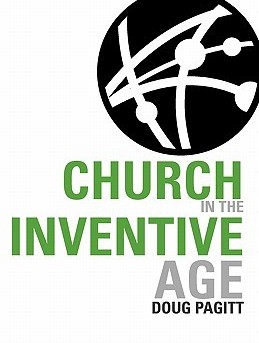
Doug has just released his latest book called The Church in the Inventive Age.  It’s a great little book, packed with powerful conversation-starting ideas about church, culture, and the future of both.  I asked Doug to answer a few questions about the book for us, which he’s graciously done below.  Enjoy!  (And go pick up his book!)

What is the Inventive Age?

I suggest that in the United States we have lived in 4 epochs (each with their own set of cultural realities: how people think, what people value, desired aesthetics, and specific tools).  They are the Agrarian Age, the Industrial Age, the Information Age and now the Inventive Age.Each of these ages are broad descriptions. The Inventive Age, roughly the 21 century, has a particular cultural sensitivity. The norms of this age will produce new artifacts just as the previous ages have done. These artifacts will include churches. Churches will have Inventive Age ways of thinking, valuing, aesthetics and tools.

What was it about this idea that felt most compelling to you?  Why write a book about it?

Since my start in Christianity in 1983 from a non-churched background I have found the cultural realities of churches to be so obvious. Strangely, others have often not noticed them at all. This includes the way churches are built, the roles of clergy, the language used, the times people meet and the meaning of the Gospel.I have seen all the “emerging” language of the last decade as a means to explore these cultural artifacts. This book is my attempt to raise these issues directly, whereas in my other books i have only referred to them.

You suggest in the early part of the book that there’s a connection between creativity and optimism.  Why do you think this is so?

I know that the more famous adage is that necessity if the mother of invention, and that certainly is true. But so is possibility the mother of invention. And the kind of invention that comes from possibility is really exciting to me. So, we are a people who not only make a hoe to drag behind a horse, but we also created a rocket to the moon. I hope we foster a culture that is only about necessity but is also about hope, optimism and possibility.

You’ve said that for the first time in history, we now have an educated and literate populace engaged in religion.  What does that mean for us?

Religion will change now that they need for the trained magisterium is no longer needed. And with 50 percent of the world population being literate, and 90% of the US population, religion will not longer be distributed to the masses from the elite. It will now have to compete with all other ideas. I think this is a really good thing and believe that the instruments of religion will need to change in this context.

What do you think is the most common mistake churches make when engaging the Inventive Age?

Hmm, maybe that they think the tools of the previous age will continue to work as they used to. I have  the image of the many phone charges and adapters I recently found in a drawer in my house. At one time they were crucial for me to use my phone, but not any more. Their time has passed. They were crucial at one time and now are stored in our junk drawer. I guess the trouble is that when we have invested so much in the tools of the church it is kinda hard to just throw them in the “junk drawer”. I mean a $40,000 seminary education isn’t exactly a phone charger. But, it might be closer than we care to admit.

If you had to just name one, what quality would you say is most essential for pastors in the Inventive Age?

Participation, collaboration, and hope. (I know that is more than one, but I think the notion of “the one thing” is part of what is changing).

What’s the most positively provocative book/podcast/blog entry/music album you’ve encountered in the past 3 months?

The TV show Dexter. It deals with addiction in a really interesting way.

Why are you so obsessed with Bruce Springsteen?

You know since the court ordered cease and desist order I don’t use the term obsessed anymore ;0). I find him to be the best American poet preacher of our time. The constant sense of hope mixed with the reality of daily life is inspiring to me. And, the guy is 60 and still doing what he does with creativity and energy. And to a 44 year old guy who still needs to do blog interviews to sell books it is good to know that I might have another 16 years of contribution left.

What is your favorite Minnesotan slang word?

Cripes.

If someone wanted to torture you by way of television, what show would be playing?

Any MTV reality shows, the Bachelor, The Amazing Race, and the interviews of contestants on The Biggest Loser.

Comments { 0 }

Happy Birthday to the BBG!

A year ago today, The Boundary Breaking God: An Unfolding Story of Hope and Promise hit the shelves.   I’ve enjoyed traveling around and talking about the ideas I share in the book, and I’ve appreciated all the emails and conversations I’ve exchanged with readers and small group members.  (If you’re in the general Dallas area and your group is reading the book, drop me a note.  I’d love to drop by and talk about it with you all!)

My intention was to create some spaces of hope for people who wondered if the story of God was too small for them, and to try to convince them as persuasively as possible that this expanding universe we live in (and the story that accompanies it) has room for far more than we often give it credit.

Here are a few interviews/podcasts/reviews of the book if you missed them:

An interview on Doug Pagitt Radio, a book review by Mustard Seed Associates, , an interview on Jason Boyett’s blog, an interview over at The Nick and Josh Podcast, and another book review by Englewood Review of Books. (The Christian Century review can only be accessed if you’re a web suscriber.  Boo.)

Thanks again to all of you who have supported the book!

*The photo above is from the Museum of Natural History in NYC.  I snagged the photo last summer while on vacation with my family.

Comments { 0 }

Salvation on the way

Happy Moltmann Monday!  In honor of my friend who is reading The Way of Jesus Christ today, here’s an excerpt from that work:

“The gospel is the light which salvation throws ahead of itself.  It is nothing less than the arrival of the coming God in the word.  We have to put it in these emphatic terms in order to be able to discern the gospel’s sacramental character:  salvation runs ahead of itself and appears in the gospel; and the gospel is the beginning in word of the epiphany of the coming God.  In the very act of its announcement, the messianic era is already put into force.  This means that the gospel is not a utopian description of some far-off future.  It is the daybreak of this future in the pardoning, promising word that sets people free.”

-The Way of Jesus Christ, p.95-96

Two things I’m contemplating today about this paragraph.  First, I really love that Moltmann doesn’t speak of salvation as property.  It isn’t something we own, like a Scout badge.  It’s more like a destination we’re running toward, because it is entirely bound up in the coming Kingdom of God.  In this way we can talk not about “having” salvation but as having glimpsed and experienced salvation on its way to something even bigger.

Secondly, I think there’s a lot to be explored in this couplet of pardoning and promising, and also in the triplet of pardoning/promising/being set free.  There is such radical and unexpected love evidenced here.  One would expect, after being pardoned, to move along quietly and humbly, attempting not to press our luck to ask for anything else.  But what does God go and do after pardoning all the ways we have been lousy excuses for human beings?  God promises us huge things, like salvation on its way to the even bigger coming Kingdom of God.  And what else would such an exchange do but set us free in a way we could hardly fathom beforehand?  We’re now without guilt, and filled up with love, and sent out to do worthwhile and right and good things in the world.  We become salvation on the way.  That, my friends, is good news.

Comments { 0 }